



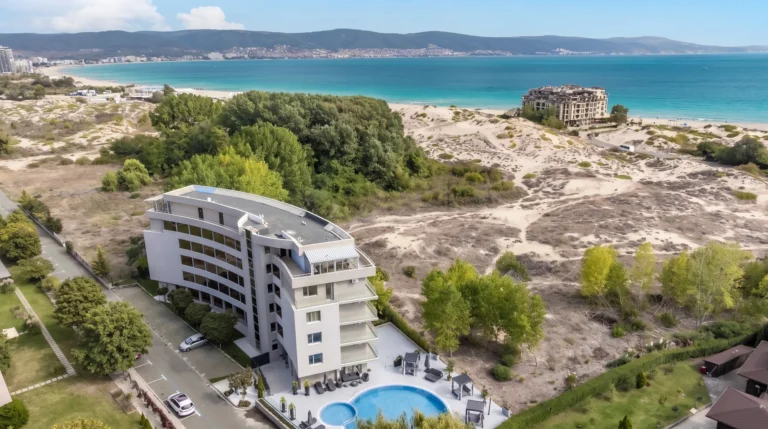


Since 1 January 2026, Bulgaria’s currency has been the euro. For buyers and owners of property, this is above all a change of monetary unit, not a change of rules. Contracts, deadlines, tax rates and loan terms remain as they were. Amounts in leva have been converted at a fixed rate and rounded to the cent.
Below we set out exactly what has changed and what has not. We rely on the Act on the Introduction of the Euro in the Republic of Bulgaria (Закон за въвеждане на еврото в Република България, hereafter the Euro Introduction Act), EU legislation, Ordinance No. 14 of Nessebar Municipality and official statistics from Bulgaria’s National Statistical Institute and Eurostat. The figures are current as of November 2026.
Virgin Build began with many years of legal practice and resale transactions, and today builds the J’Adore series of complexes in Sunny Beach. That is why we look at the changeover in practical terms: what it means for the transaction, taxes, loans and payments.
What formally changed in Bulgaria on 1 January 2026
Since 1 January 2026, the euro has been Bulgaria’s legal currency, and the conversion rate is fixed permanently: €1 = 1.95583 leva.
The decision was taken by the Council of the EU on 8 July 2025. Council Decision (EU) 2025/1407 confirmed that Bulgaria met the conditions and abrogated its derogation from the eurozone with effect from 1 January 2026. The rate was written into Regulation (EC) 2866/98 by Council Regulation (EU) 2025/1409.
In Bulgarian law, the same is set out in the Euro Introduction Act. Art. 4 names the euro as the country’s currency; Art. 5 refers to the “irrevocably fixed” rate of the lev to the euro. The Act was published in the State Gazette (Държавен вестник) No. 70 of 20 August 2024 and has been amended several times since.
The changeover happened in a single step. Cashless and cash euros arrived on the same day, with no transitional period (Regulation (EU) 2025/1408). Lev banknotes and coins remained legal tender for one more month, until 31 January 2026 (Art. 24 of the Act).
EU law allows up to six months of dual circulation (Regulation (EC) 974/98, Art. 15), and national law may shorten that period. Bulgaria shortened it to one month.
For a foreign buyer, something else matters more: the rate is not new. From 1999 the lev was pegged one to one to the Deutsche Mark, and through it to the euro at the same rate of 1.95583 (Bulgarian National Bank Act, Закон за Българската народна банка, Art. 29). From July 2020 the lev was in the ERM II exchange rate mechanism at the same central rate.
If you were already calculating your purchase in euros, the currency side of the transaction has, in practice, not changed for you.
Which transitional deadlines had already expired by November 2026
The move to the euro came with temporary rules. Most of them had run their course by the end of 2026.
Dual price display. Prices of goods and services for consumers had to be shown in both euros and leva from 8 August 2025 to 8 August 2026 (Art. 15 of the Act). Since 9 August 2026 this requirement no longer applies, and prices are shown in euros.
Exchanging leva at banks. Commercial banks exchanged leva for euros free of charge for the first six months, until 30 June 2026. After that they may charge a fee, but for 12 months from the date the euro was introduced, that is until the end of 2026, they may not refuse an exchange (Art. 26).
Exchange at the national bank. The Bulgarian National Bank exchanges lev banknotes and coins for euros free of charge and with no time limit (Art. 26(1)).
According to the national bank, by 30 June 2026 some 29.4 billion leva had been exchanged for euros. That is 94.48% of all lev banknotes and coins in circulation at the start of 2025.
Protection against unjustified price rises. This rule is not temporary. Converting prices may not leave the consumer worse off, and the introduction of the euro in itself may not be grounds for raising prices without objective economic reasons (Art. 7).
Interactive insightsWhat your budget buys by the seaPrice per m² in Sunny Beach against Munich, Prague and Warsaw, Eurostat price and inflation data — and J’Adore residences matched to your goals.Open the insights →What happened to contracts, prices and tax valuations in leva
Contracts in leva remain in force without being re-signed. The amounts in them are read as amounts in euros at the official rate.
This is a direct provision of Art. 11 of the Euro Introduction Act. The introduction of the euro does not affect the validity of existing legal instruments that refer to the lev (para. 1). Amounts in leva are read as amounts in euros under the conversion and rounding rules (para. 2). A reference to the lev without a specific amount is read as a reference to the euro (para. 4). The same logic is built into EU law: Regulation (EC) 974/98, Art. 14.
In practice, this covers any document signed before 2026: the preliminary contract, the notarial deed, the contract with the complex’s management company, the lease. All of them remain valid.
Deadlines do not change either. The introduction of the euro does not move any contractual deadline and does not give either party the right to amend or terminate a contract unilaterally (Art. 11(3); Regulation (EC) 1103/97, Art. 3). The parties are, however, free to agree otherwise.
The conversion rules are strict, so that no one gains or loses on rounding.
The amount in leva is divided by the full rate of 1.95583 — with all five decimal places. The rate is neither rounded nor shortened (Art. 12; Regulation 1103/97, Art. 4).
The result is rounded to the cent on the third decimal place: below five rounds down, five or above rounds up (Art. 13). For example, 1,000 leva is €511.29, and 250,000 leva is €127,822.97. Property owners will recognise the latter figure from the inheritance tax rules: it is the same threshold, converted from the former 250,000 leva.
Banks converted lev accounts into euros once, on 1 January 2026, with no fees or charges to the customer (Art. 28(1)).
State and municipal registers were converted in the same way, automatically (Art. 47(1)). The tax valuation of an apartment (данъчна оценка) is held in the municipal registers. Since the introduction of the euro, notices for property tax and the household waste fee arrive with amounts in euros (Art. 50(2)).
Unpaid taxes and other public debts were converted into euros on the date of introduction (Art. 42). From 2026, all payments to the state and municipalities are accepted and collected in euros (Art. 52).
Have property taxes and fees changed since the switch to the euro
No, only the currency has changed. The Euro Introduction Act converts amounts but does not change tax rates expressed as percentages.
The framework for the annual property tax is set by the Local Taxes and Fees Act (Закон за местните данъци и такси): from 0.1 to 4.5 per mille of the tax valuation (Art. 22(1)). The specific rate within that range is approved by the municipal council.
In Nessebar Municipality, which includes Sunny Beach, Sveti Vlas and Nessebar itself, the rate for 2026 is 2.2 per mille, or 0.22% of the tax valuation (Ordinance No. 14, Art. 18). It was approved by the municipal council by Decision No. 584 of 16 December 2025. This is an independent decision of the municipality, unrelated to the euro.
The tax valuation is, as a rule, below market price. The tax can be paid in two instalments — by 30 June and by 31 October. Paying the full amount by 30 April earns a 5% discount. Both deadlines for 2026 have passed; notices for next year will arrive in euros.
The local tax on buying an apartment in Nessebar is 3.0% of the higher of two figures: the contract price or the tax valuation (Ordinance No. 14, Art. 41(2)). The changeover did not affect the percentage. A separate fee of 0.1% is paid for entry in the Property Register.
The household waste fee (такса битови отпадъци) for residential properties in Nessebar and the Sunny Beach resort for 2026 is 1.38 per mille of the tax valuation. It is made up of three parts: collection and removal of waste (0.20‰), cleaning of public areas (0.82‰) and waste treatment (0.36‰). The basis is Decision No. 586 of Nessebar Municipal Council of 16 December 2025 (minutes of the session).
Ordinance No. 14 itself already gives amounts in both currencies, for example “1000 лв./511,29 евро”. The conversion in it follows the rules of the Euro Introduction Act.
One detail for those who check the figures. Most amounts in legislation were converted exactly at the rate, but certain thresholds were fixed at a new, rounded amount in euros. For instance, the mandatory VAT registration threshold from 2026 is €51,130 (Value Added Tax Act, Закон за данък върху добавената стойност, Art. 96(1)). An exact conversion of the former 100,000 leva would give €51,129.19. Thresholds are therefore best checked in the current text of the law rather than converted yourself.
We cover every tax an owner faces — on purchase, ownership, letting, sale and inheritance — in a separate guide to property taxes in Bulgaria.
What official house price statistics show
According to the National Statistical Institute (Национален статистически институт), in the second quarter of 2026 house prices in Bulgaria rose by 4.5% on the first quarter and by 15.5% on the second quarter of 2025. The release was published on 23 September 2026. These are the latest official data as of November 2026.
The picture in the largest cities in the same quarter, compared with the previous quarter: Plovdiv +5.8%, Stara Zagora +2.9%, Varna +2.8%, Sofia +2.4%, Burgas −1.5%.
Eurostat provides a longer series. Annual house price growth in Bulgaria: second quarter of 2025 +15.5%, third +15.4%, fourth +12.6%, first quarter of 2026 +14.8%, second +15.5% (provisional data, updated 1 October 2026).
In the second quarter of 2026, new dwellings rose in price by 12.3% year on year, existing dwellings by 17.6%. Average annual growth was 16.5% in 2024 and 14.6% in 2025.
For comparison: in the EU-27, annual growth in the second quarter of 2026 was 4.7%; in the eurozone, including Bulgaria, 4.0%.
Double-digit price growth was recorded before 2026 as well. The official index shows how prices change but does not break that change down by cause. These statistics do not allow the effect of the euro on house prices to be measured separately.
It helps to understand what the index actually measures. It covers purchases by households of new and existing dwellings at market prices, including the value of the land. Self-build and non-market transactions are excluded. Data for each quarter are released roughly three months after it ends.
There is no separate official index for Sunny Beach or Nessebar Municipality. The National Statistical Institute publishes data for the country as a whole and for its six largest cities. The resort market works in its own way, so national figures are a backdrop, not the price of a particular apartment by the sea.
Past performance does not indicate future performance. We do not make price forecasts and recommend relying on the facts of the specific property.
What the euro changes for buyers from outside the eurozone
For a buyer from a country outside the eurozone, currency risk means the exchange rate of their own currency against the euro. That risk existed before 2026 as well, because the lev was firmly pegged to the euro.
For buyers from Poland, the Czech Republic, the United Kingdom, Switzerland, Hungary and Romania, nothing has fundamentally changed. The zloty, koruna, pound, franc, forint and leu fluctuate against the euro, and the European Central Bank publishes daily reference rates for them. The Bulgarian lev is no longer on that list.
For buyers from the UAE and Saudi Arabia, the currency factor is the euro’s rate against the US dollar. The dirham and riyal are pegged to the dollar, so EUR/USD movements determine what the purchase costs in the home currency.
The apartment price, taxes, waste fee, the complex maintenance fee and rental income are all in euros. A buyer from outside the eurozone therefore benefits from being clear on two things in advance:
- where, and at what rate, they will convert the funds for the purchase;
- in which currency they would prefer to receive rental income and pay annual costs.
For a buyer from the eurozone — Germany, Austria, Slovakia, Ireland and others — the picture is simpler. The price, local taxes and fees, maintenance and rental income are now in the same currency as at home. No conversion is needed at all.
How the euro affected mortgages and foreign-currency loans
Loans in leva became loans in euros, and the terms of the agreements were preserved. A fixed rate stays as agreed (Art. 44(4) of the Euro Introduction Act).
A different rule applies to variable rates. If the previous benchmark has been discontinued or materially changed, an alternative one applies (Art. 44(1)). The bank notifies the customer of the changes (para. 2). On the date the euro was introduced, the new rate could not be higher than the old one (para. 3). After that it moves with the benchmark, as the agreement provides.
From 1 January 2026, the Bulgarian National Bank no longer calculates or publishes the base interest rate or the LEONIA Plus index. Monetary policy for Bulgaria is now set by the Governing Council of the European Central Bank, as for the whole eurozone. The Governor of the Bulgarian National Bank sits on that council. The rate on a particular mortgage is still set by the bank in the loan agreement.
If a buyer earns income in a currency other than the euro, or lives in a country outside the eurozone, a euro mortgage is for them a “foreign currency loan” within the meaning of Directive 2014/17/EU (Art. 4(28)). For such loans, the directive requires protective mechanisms (Art. 23).
In Bulgaria these rules are set out in the Consumer Credit for Immovable Property Act (Закон за кредитите за недвижими имоти на потребители). The borrower has the right to convert the loan into the currency in which they mainly receive their income, or into the currency of their country of habitual residence (Art. 33). The lender must notify the borrower if the size of repayments has changed by more than 20% due to the exchange rate, and remind them of the right to convert the loan into another currency (Art. 34).
How bank transfers for a purchase now work
Transfers are predictable. Euro payments within the EU follow SEPA rules (Regulation (EU) 260/2012). The payee’s bank must be reachable for SEPA transfers (Art. 3). The payer may not require the payee’s account to be held in a particular EU country (Art. 9).
SEPA applied to euro payments in Bulgaria before 2026 too. What is new is that all domestic Bulgarian payments are now in euros as well.
The cost of a transfer is also governed by EU law. A bank’s charge for a cross-border euro payment within the EU equals its charge for a domestic payment of the same amount in the national currency of the bank’s country (Regulation (EU) 2021/1230, Art. 3).
For a buyer from Poland or the Czech Republic, this means a euro transfer costs the same as a domestic transfer in zloty or koruna. Currency conversion is a separate service with its own cost, and it is worth comparing in advance.
Payments initiated in leva before the changeover and completed afterwards were executed in euros (Art. 29(1) of the Euro Introduction Act).
What determines the price per square metre by the sea
The price per square metre in a resort is determined by the property itself: distance to the beach and the view, the construction stage, the building’s tax status, the complex’s amenities and the cost of running it. The currency has no bearing on these factors.
Distance to the sea and the view. “First line” is a market term, not a legal one. It should not be confused with zone “A” under the Black Sea Coast Spatial Development Act (Закон за устройството на Черноморското крайбрежие), which is a separate concept with its own building regime. Proximity to the water and an open sea view are usually reflected in the price more than anything else.
Construction stage. Before the structure is complete, what is bought is the right to build a future property. Completion of the rough construction stage (груб строеж — frame and roof) is certified by a protocol of the municipal administration (Spatial Development Act, Закон за устройство на територията, Art. 181(2)). The apartment can be used once the building has been put into service under a use permit or certificate (Art. 177 of the same Act). Each stage changes the balance between risk and price. We describe the stages in detail in our article on Acts 14, 15 and 16.
VAT. The sale of a new building is subject to VAT; the sale of a building that is no longer new is exempt (Value Added Tax Act, Art. 45(3)). That is why, in a new development, it matters whether VAT is included in the price.
Amenities and running costs. The pool, security, reception, landscaping, management. All of these shape both the entry price and the annual maintenance fee for the complex.
There are no official price statistics for the resort, so the prices of specific projects serve as the benchmark. Prices in our J’Adore complexes are stated in euros, with VAT included in the price.
J’Adore Dune is a completed complex on the first line by the sea; J’Adore Blanc is under construction, with completion scheduled for December 2027. The price difference between them reflects the factors described above: location and construction stage. Current prices for each apartment are in the price lists on the complex pages, which we update regularly.
Frequently asked questions
Do I need to re-execute a contract or notarial deed drawn up in leva?
No. Contracts that refer to the lev remain in force, and the amounts in them are read as amounts in euros at the rate of 1.95583 (Euro Introduction Act, Art. 11). Deadlines and obligations do not change.
At what rate, and how, were amounts in leva converted?
The amount in leva is divided by 1.95583 without rounding the rate. The result is rounded to the cent: if the third decimal is below five, it rounds down; five or above, it rounds up. For example, 1,000 leva = €511.29.
Can leva still be exchanged for euros?
Yes. At the Bulgarian National Bank, free of charge and with no time limit. Commercial banks exchanged free of charge until 30 June 2026; they may now charge a fee, but until the end of 2026 they may not refuse an exchange.
Have property taxes changed because of the euro?
No. The Euro Introduction Act converted amounts but did not change rates. The property tax rate, within a range of 0.1–4.5 per mille, is set by the municipal council. Tax notices arrive in euros.
What happened to mortgages taken out in leva?
They became euro mortgages on the same terms. A fixed rate did not change. A variable rate could not rise above its previous level on the changeover date; after that, it follows the benchmark.
Is there currency risk for a buyer from outside the eurozone?
Yes: the rate of their own currency against the euro, and for currencies pegged to the dollar, the EUR/USD rate. This risk existed before 2026 too, because the lev was pegged to the euro.
Did house prices in Bulgaria rise because of the euro?
Official statistics record rising prices but do not isolate the effect of the euro. Double-digit average annual growth was already present before the changeover: 16.5% in 2024 and 14.6% in 2025 (Eurostat).
The switch to the euro has made Bulgarian property simpler to calculate, but it has not changed what matters most: the decision to buy still rests on the qualities of the specific property and on a clear legal basis for the transaction.
Virgin Build handles the purchase from start to finish: lawyers, translator, management. If you still have contracts or payments made in leva, or would like to see how the transaction looks in your own currency, write to us at sales@virginbuild.com.
Further reading:
Property taxes in Bulgaria for foreigners — the complete 2026 guide
Act 14, Act 15, Act 16: how buying an off-plan apartment in Bulgaria works
J’Adore Dune — complex page
We will recalculate your purchase in euros
Our lawyers will review contracts and payments made in leva and show you how the purchase looks in your own currency.
Continue reading
All articles → ArticleIs an apartment on the Bulgarian coast worth buying? How to make a considered decision in 2026The pros and cons of an apartment on the Bulgarian coast, with no promises of yield: purpose, costs, tax on letting and resale, and the…Read →
 ArticleProperty Taxes in Bulgaria for Foreign Owners — The Complete 2026 GuideComplete 2026 guide to Bulgarian property taxes for foreign owners: purchase, ownership, rental, sale, inheritance. Rates in EUR.Read →
 ArticleSunny Beach, Nessebar, Sveti Vlas, Pomorie or Burgas: how to choose where to buy an apartment on Bulgaria’s southern coastFive locations within about 40 km of Burgas Airport, five different ways to own by the sea. We compare Sunny Beach, Nessebar, Sveti…Read →
 Under constructionJ’ADOREBlanc 1–2
 CompletedJ’ADORESecret Garden
 Completed · front lineJ’ADOREDune