




When someone first seriously considers an apartment in Bulgaria, taxes usually cause more anxiety than the transaction itself. How is tax paid at purchase? How much each year afterwards? What about renting it out? What about selling, or passing it on to the children?
In practice, Bulgarian law sets all of this out clearly enough. The rates are low by European standards, and the rules are identical for Bulgarians and foreigners. Moreover, you can pay most taxes remotely. In this guide we walk through every type of tax a Nessebar Municipality apartment owner will encounter. That covers the purchase, the years of ownership, renting, selling and passing the property to family. The guide draws on Nessebar Municipality Regulation No. 14 (in the version effective from 1 January 2026), the Local Taxes and Fees Act and the Personal Income Tax Act.
Since 1 January 2026 Bulgaria is in the eurozone, so this guide gives all rates in euros.
Do foreigners pay more property tax than Bulgarians?
No. For Bulgarian real estate, every core rate is the same for residents and non-residents. This applies to purchase tax, annual property tax, rental income tax, capital gains tax on sale, inheritance and gift tax. The owner’s nationality changes neither the rate nor the base.
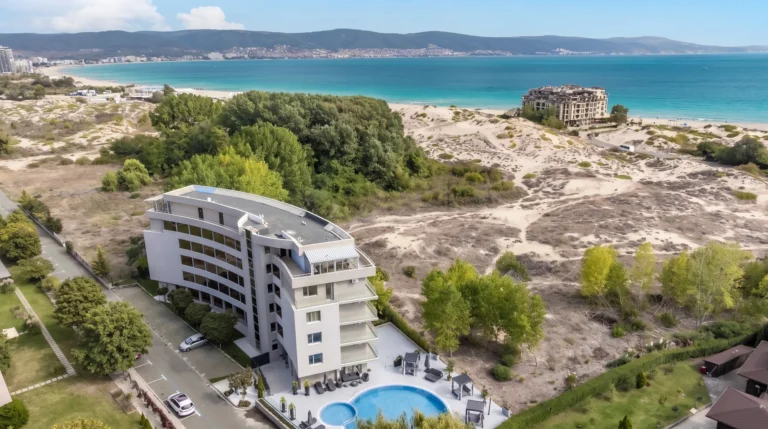
What does depend on tax residency, however, is where you declare your worldwide income. A Bulgarian tax resident declares worldwide income in Bulgaria, while a non-resident declares only Bulgarian-source income. But that is a separate matter from your specific apartment. So for your apartment in J’adore Dune, the rates are identical to those your neighbour from Burgas pays.
This is the first thing worth pinning down before reading the rest: the country does not “penalise” you for being foreign. The tax system does not work that way.
Taxes and fees at purchase
When closing a purchase in Nessebar Municipality, a foreign buyer faces several separate payments.
Local property transfer tax (данък при възмездно придобиване на имущество) — the principal transaction tax. Under Nessebar Municipality Regulation No. 14 (art. 41 para. 2) the rate is 3.0% of the assessed property value. The base is the price stated in the notarial deed. However, the deed price cannot be lower than the tax assessment value.
Notary fee — set by the tariff of the Bulgarian Notarial Chamber. The scale is regressive, so the percentage drops as the deal size rises. For premium apartments this works out to roughly 0.5–1% of the transaction price. The tariff also has a cap at the upper end.
Property Register entry (Имотен регистър) — 0.1% of the deal value, paid to the Registry Agency at closing.
VAT, BULSTAT and service costs
VAT. Buyers often overlook this point, so it is worth being clear. VAT applies only if the developer is VAT-registered and the unit is the first sale of new housing. In that case, the price includes 20% VAT. We sell our apartments in J’adore with VAT already included in the price. As a result, there is no add-on for the buyer: the figure in the contract is the figure you pay.
BULSTAT. This is the unique registration number assigned to each property owner in Bulgaria, foreign owners included. The registration itself is an administrative procedure at the Registry Agency. The important rule: the BULSTAT filing must take place within seven working days of the notarial deed. At Virgin Build, our standard purchase support package includes BULSTAT. The client therefore receives their number as part of the closing, with no additional effort required. Our lawyers handle the entire process, so the buyer does not need to take part.
Additional costs for the buyer — document translations, legalisation if needed, lawyer’s fees, bank transfer fees. These are not state taxes but service costs, and their amount varies case by case.

Annual property tax in Nessebar Municipality
Bulgarian law calls the principal annual ownership tax данък върху недвижимите имоти (“real property tax”). Nessebar Municipality covers Sunny Beach, Sveti Vlas, Nessebar itself and surrounding villages such as Ravda, Tankovo and Kosharitsa. Across this territory, the Municipal Council sets the rate and records it in Regulation No. 14, art. 18. From 1 January 2026 it stands at 0.22% of the tax assessment value of the apartment. This is one of the most owner-friendly rates on the Bulgarian Black Sea coast.
The municipality calculates the tax not on market price but on the tax assessment value (данъчна оценка). A municipal tax officer determines this figure using the formula in Appendix No. 2 of the Local Taxes and Fees Act. The formula takes into account apartment area, building type, location, year of construction, depreciation and other parameters. The tax assessment value is almost always noticeably lower than market price. That works in the foreign buyer’s favour, because the tax applies to a smaller base. Your first tax notice shows the specific assessment value of your apartment. You can also request a certificate from the municipality at any time.
How property taxes in Bulgaria are paid
The tax falls due in two equal instalments: the first between 1 March and 30 June, the second by 31 October. Bulgaria also rewards early payment: pay the full annual amount by 30 April and you receive a 5% discount (Regulation No. 14, art. 23 para. 2).
In addition, payment works entirely remotely. Options include the ePay system, bank transfer to the municipality’s account, or a lawyer or representative under power of attorney. If you live abroad, the most convenient option is a Bulgarian representative. You set this up once, and then it runs automatically.
A separate but logically related payment is the waste collection fee (такса смет / такса битови отпадъци). This is not a tax but a municipal charge for waste removal and the cleaning of common public areas. A separate municipal formula determines the amount, which is usually smaller than the property tax itself. In practice the waste fee arrives with the tax notice, so you need no separate trip to the municipality.
Maintenance fee — this is not a tax
Owners often confuse this line with a tax, so let’s separate the two. Maintenance fee is the annual contribution to common-area upkeep (swimming pool, security, reception, lifts, landscaping, insurance of common property). Owners pay it to the management company of the complex, not into the municipal budget. It has no legal connection to the property tax or the waste fee. Instead of the Local Taxes and Fees Act, the Condominium Management Act and decisions of the general assembly of owners govern it.
For J’adore Secret Garden the rate is 18 euros per square metre per year including VAT. For J’adore Dune, by contrast, it is 15 euros per square metre per year without VAT. What the fee includes and how the management company works — we covered this in detail in our article “Buying an Apartment from a Developer in Bulgaria”.
Rental income tax
If you rent the apartment out in Bulgaria — short-term via Booking, mid-term, or long-term — the income is taxable. The rate is the standard 10% personal income tax.
But here is a practical detail that almost every overview skips. Under Article 31, paragraph 1 of the Personal Income Tax Act, when a private individual earns income from renting out real property, the law recognises 10% statutory expenses. The law defines them as “expenses on maintaining the property, recognised without documentary proof”. So the taxable base is not your gross rental income but gross rental income minus 10%. The 10% tax then applies to that reduced base.
In practice this looks like this. Say you receive 10,000 euros from rental in a year. The taxable base is then 9,000 euros, and the tax is 900 euros — effectively 9% of gross revenue, not 10%. The rule applies automatically, so you do not need to collect receipts or invoices to use it. Half the agency websites do not mention this at all, even though the saving is tangible in the owner’s pocket.
You file the personal income tax return for the previous year by 30 April of the current year. The tax is also due by that deadline. Filing takes place electronically through the National Revenue Agency, so no physical presence in Bulgaria is necessary.
Individual or company: choosing the structure
When a company structure is more efficient. If you own one apartment and the income is moderate, the simple model is usually the most efficient. That model is “private individual + 10% tax on the base less 10% expenses”, and it requires almost no administration. A company structure becomes worth considering when you manage several properties at once. It also makes sense when rentals become a genuine business with staff, operating costs and depreciation. Here the options are a sole trader or a single-owner company. Bulgarian corporate tax is also 10%. However, accounting costs appear, while a wider set of expenses becomes legitimately deductible. The right calculation for your situation is a conversation with our lawyer, who can map both sides: income and structure.
Booking as a channel works in the standard way. The owner receives the revenue and pays tax under the scheme above. However, Booking does not withhold any Bulgarian tax on your behalf — that responsibility sits with the owner.
Tax on the sale of the apartment
This is probably the most important rule for long-term planning. It directly affects what you walk away with when you exit the investment. Bulgarian law is on the owner’s side here, but there are specific thresholds worth knowing.
The core rule is in Article 13, paragraph 1, item 1 of the Personal Income Tax Act. Income from the sale of one residential property is tax-exempt if you have owned it for at least three years. In other words, if you sell three years and one day after buying, the tax on the gain is zero. This holds regardless of the size of the gain.
The picture changes when an owner sells two or more residential properties in a single calendar year. In that case, the exemption for each requires five years of ownership. This is an anti-flipping rule. It does not apply to a single owner selling their only or second apartment in different years.
Selling before the threshold: 10% on the gain
If you sell the apartment earlier than the three-year (or five-year) threshold, a 10% tax applies to the gain. The tax falls not on the sale price but on the gain. The gain is the sale price minus the acquisition price (придобивна цена — the documented purchase price from the notarial deed). Documented expenses on property improvements also reduce it. Renovation and improvement costs are deductible if invoices and payment records back them up. That is why it makes sense to keep these documents from the moment of purchase. Expenses without documentary proof, however, do not enter the base.
You will see incorrect formulations online: “you can sell after one year tax-free” or “you need five years of ownership”. The correct answer, however, is three years for a single property, five years for several in the same calendar year. The rule sits in Article 13 of the same law and has not changed since its introduction. If you read otherwise, the source is either out of date or simply wrong.
Timing the sale and filing the return
Sometimes this knowledge directly influences the timing of a transaction. For example, if the three-year mark is four months away, waiting lets you close at zero tax. If your ownership horizon is long anyway, the tax window works in your favour automatically. This applies, for instance, to a summer apartment for the family or an investment held for appreciation.
You file the sale return within one month of the notarial closing. If a gain arises, that same month is also the deadline for paying the tax. If the 3/5-year exemption applies, you pay no tax but still declare the transaction. Virgin Build lawyers prepare and submit this package, including by power of attorney if you are not in the country.
Double taxation — what it actually means for your wallet
Every foreign owner eventually wonders: I pay tax in Bulgaria — won’t my country of residence tax the same income again?
The basic principle of international tax law: the country where the property stands taxes income linked to real estate. So Bulgaria taxes your Sunny Beach rental income. Your country of residence then does one of two things, depending on the specific treaty. It either exempts this income from a second round of tax or credits your Bulgarian tax against the local one.
Bulgaria has signed Double Taxation Avoidance Treaties with virtually every European country and most of the former Soviet space. This includes Germany, Poland, Slovakia, the Czech Republic, Israel, Ukraine, Russia and many others. The Bulgarian Ministry of Finance (minfin.bg) publishes the current list.
How the credit or exemption works
The exact mechanism of credit or exemption depends on your country of residence. It also depends on the type of income (rental, gain on sale, gift). For rental and sale of Bulgarian real estate, however, the general principle is almost always the same. The Bulgarian tax exhausts the obligation on that income, and your country of residence does not “top it up”. But the details are a job for a specialist in both jurisdictions. Typical examples are crediting the tax in Germany or declaring the Bulgarian apartment to the Polish tax office.
This is where our lawyers come in. We have been supporting foreign owners for years, so we know how to untangle a specific situation. We also know which counterparty abroad to ask for a missing certificate. Finally, we know how to file the declarations correctly so that you do not pay twice. For us this is routine.
Inheritance and gift tax
Overviews usually skip this block entirely. However, almost every family buyer asks: “If something happens to me — what will my family owe the Bulgarian state?”
The good news: Bulgarian law in this area is very favourable.
On inheritance, under the Local Taxes and Fees Act and Regulation No. 14 art. 26 para. 2, the surviving spouse and heirs in the direct line (children, grandchildren, parents) without limit are fully exempt from inheritance tax. So if the apartment passes to your spouse or your children, the inheritance tax is zero.
By contrast, tax arises only for other categories of heirs. For siblings and their children, the rate is 0.5% on the portion of the inheritance share exceeding 127,822.97 euros (Regulation No. 14, art. 31). For all other heirs, the rate is 4.0% on the portion exceeding 127,822.97 euros. A fixed amount of 511.29 euros for funeral expenses also comes off the taxable base.
The deadline for filing the inheritance declaration is 6 months from the opening of the inheritance. Heirs must then pay any tax due within 2 months from the date of the municipal notice.
Gift tax within the family
On gifts, the logic is similar. Under Article 38, paragraph 6 of the Local Taxes and Fees Act, gifts between spouses and between relatives in the direct line (parent — child — grandchild) carry no tax at all. This means you can transfer the apartment to your child during your lifetime. The gift itself triggers no tax consequences.
For gifts between siblings and their children, however, the rate is 0.5% of the value of the gifted property. For gifts between all other persons the rate is 5.0% (Regulation No. 14, art. 41).
The conclusion for long-term ownership is straightforward: Bulgarian real estate passes through the family without friction. This is a clear advantage for buyers thinking on the “we’ll pass it on to the children” horizon. In our premium segment, that is most of them. If complex family arrangements arise — several heirs, fractional ownership, transfers with conditions — our lawyers handle these. For us no case is impossible.

The owner’s tax calendar for 2026
To keep all the dates in one view, here is what a Bulgarian apartment owner’s tax year looks like.
January — April. Prepare last year’s income return if you rented the apartment. In parallel, pay the property tax and waste fee for the current year. Act before 30 April and the 5% discount applies.
By 30 April. Final deadline to file the personal income return for the previous year (rental income) and pay the tax. Last day to pay the annual property tax with the 5% discount.
By 30 June. Deadline for the first half of the property tax and waste fee. This applies if you did not pay everything in a single April payment with the discount.
By 31 October. Deadline for the second half of the property tax and waste fee.
Throughout the year. If you sell the apartment during the year, the sale return is due within one month after the transaction. The same deadline applies to capital gains tax, if applicable. If you receive property as a gift, the deadline for the declaration and any tax due is two months from receipt. If you inherit, the declaration is due within six months of the opening of the inheritance. The tax is then due within two months of the municipal notice.
Virgin Build handles most of these deadlines together with our lawyers. As a result, the client receives reminders and final confirmation that every payment went through on time.
Frequently Asked Questions
What is the property tax rate in Nessebar Municipality in 2026?
0.22% of the apartment’s tax assessment value (Regulation No. 14 art. 18, as amended on 16 December 2025, in force from 1 January 2026). The tax assessment value is usually lower than market price. If the full annual amount is paid by 30 April, a 5% discount applies.
Do foreigners pay more property tax than Bulgarians?
No. All rates on Bulgarian real estate are identical for residents and non-residents: purchase tax, annual property tax, rental income tax, capital gains tax on sale, inheritance and gift tax.
After how many years can the apartment be sold tax-free?
After three years of ownership for a single residential property. The rule is set out in Article 13, paragraph 1, item 1 of the Personal Income Tax Act. If two or more properties are sold in the same calendar year, each requires five years of ownership.
Is VAT charged on the purchase of a new-build apartment from a developer?
It depends on the seller. 20% VAT is included in the price if the seller is VAT-registered and the apartment is sold as the first sale of new housing.
What is the tax rate on rental income from a Bulgarian apartment?
10% personal income tax. The base is reduced by 10% statutory recognised expenses (Article 31, paragraph 1 of the Personal Income Tax Act) with no need for documentary proof. The effective rate is approximately 9% of gross revenue.
Is it better to rent the apartment as an individual or through a company?
For a single apartment, the individual route is usually more efficient: less administration, the same 10% rate as corporate tax. A company makes sense when managing several properties or when the rental becomes a full business. A precise calculation for your situation is something our lawyers will do.
Is inheritance tax due when an apartment passes to children or a spouse?
No. Under the Local Taxes and Fees Act, the surviving spouse and heirs in the direct line (children, grandchildren, parents) are fully exempt from inheritance tax. Tax arises only for collateral lines of heirs.
Is gift tax due when an apartment is gifted to a child?
No. Under Article 38, paragraph 6 of the Local Taxes and Fees Act, gifts between spouses and in the direct line (parent — child — grandchild) are not taxed.
What is the local tax rate on purchasing an apartment in Nessebar Municipality?
3.0% of the assessed value of the transaction (the higher of the contract price and the tax assessment value) — Regulation No. 14 art. 41 para. 2.
Can Bulgarian property taxes be paid remotely without travelling to the country?
Yes. Through the ePay system, by bank transfer to the municipality’s account, or through a lawyer under power of attorney. There are no restrictions by nationality or residence on remote payment.
Buy calmly. We handle the rest.
If you already own an apartment in one of our complexes or are considering a purchase — the tax side can sit entirely on our side. Virgin Build, together with its in-house legal practice, handles legal support for owners: BULSTAT filing, registering the apartment with the tax authority, supporting sale and inheritance transactions, representing your interests before the tax office and Nessebar Municipality. This is routine work for our team.
Continue reading
All articles → ArticleApartment Ownership in Bulgaria: What a Foreign Buyer Receives and How the Law Protects the PurchaseWhat the notarial deed records, why the land is not part of the purchase and what a building right is. How Bulgarian law protects the foreign buyer: the notary, the Property Register, the Constitution.Read →
 ArticleBuying an Apartment from a Developer in Bulgaria: What International Buyers Need to Know in 2026A Bulgarian developer's guide for international buyers: new-build warranties, Nessebar property tax 0.22%, BULSTAT, realistic rental yield.Read →
J’Adore residences
 Under constructionJ’ADOREBlanc 1–2
 Completed · front lineJ’ADOREDune
This article is based on the Bulgarian Local Taxes and Fees Act, the Personal Income Tax Act and Nessebar Municipality Regulation No. 14 in the version effective from 1 January 2026. The information is for general reference and does not replace personal tax and legal advice.