



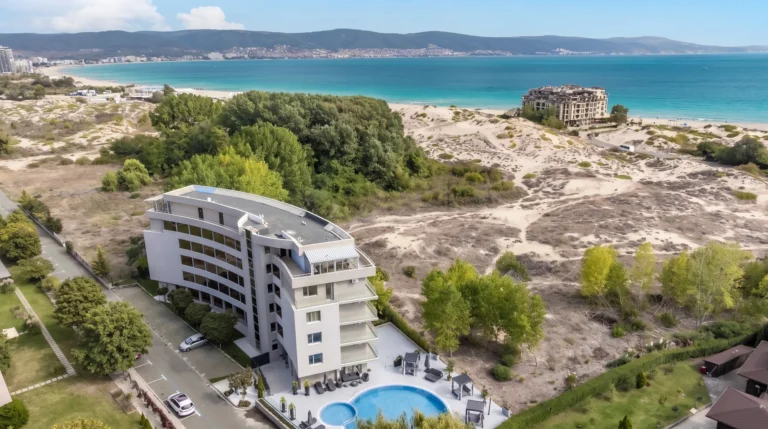
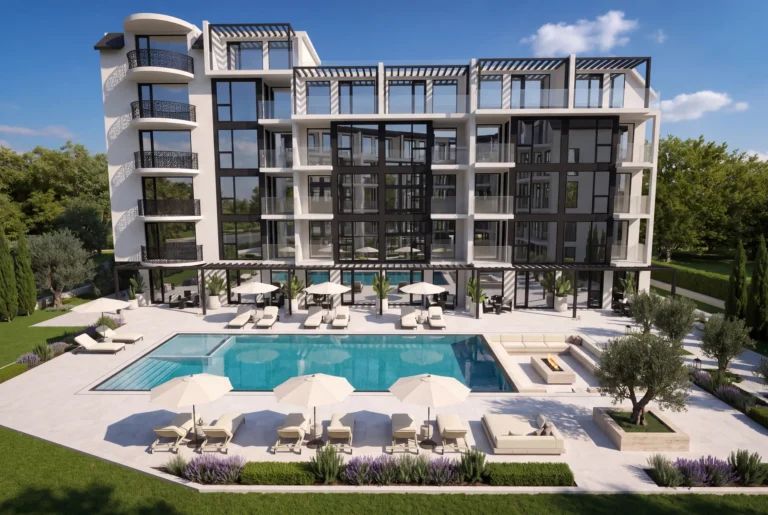

An apartment’s price is paid once; its upkeep is paid every year. For an owner in Sunny Beach, the annual costs come down to a few lines: the complex’s maintenance fee, property tax, the household waste fee, personal utility bills and, if the owner chooses, insurance.
These payments work in different ways. Some go to the municipal budget and rest on tax law. Others are received by the complex’s manager — under a contract or by decision of the general meeting of owners. That difference determines who sets the amount, who can change it and how the owner can influence the decision.
Virgin Build is the Bulgarian developer of the J’Adore series of complexes in Sunny Beach. J’Adore Secret Garden and J’Adore Dune have already been commissioned; J’Adore Blanc is under construction. We look at the subject from a developer’s perspective, drawing on Bulgarian legislation and the decisions of Nessebar Municipal Council for 2026.
What the maintenance fee is and how it differs from a tax
The maintenance fee (такса поддръжка) is a charge for the upkeep of a complex’s common parts, which the owner pays to the manager rather than to the state. It is not a tax: it has a different legal basis and a different recipient.
The name itself is a market term. The Condominium Management Act (Закон за управление на етажната собственост) does not use the words “такса поддръжка”. The Act speaks of the costs of managing and maintaining the common parts of a building and obliges owners to pay them (Art. 6(1), item 10).
Taxes work differently. Under the Constitution of the Republic of Bulgaria (Art. 60(1)), taxes and charges are established by law. The list of local taxes is set by the Local Taxes and Fees Act (Закон за местните данъци и такси, Art. 1). Within the limits set by law, their amount is determined by the municipal council in its own ordinance. The money goes to the municipal budget.
The maintenance fee pays for specific work: security, cleaning, the pool, the gardens, technical maintenance. The recipient is a management company, a manager or an owners’ association.
In practice these are separate bills. Property tax and the waste fee come from the municipality. The maintenance fee comes from the complex’s manager. They have different deadlines and different rules for change.
The legal basis for the fee: a contract or the general meeting
The basis depends on the building’s regime. For a gated residential complex, the law provides for a contractual model. In all other cases, the general rules apply, with a general meeting of owners.
The contractual model. Under the Condominium Management Act (Art. 2(1)), the management of common parts of buildings in a gated residential complex is governed by a written contract between the investor and the owners. The signatures are certified by a notary. The investor registers the contract with the Registry Agency (Агенция по вписванията) against the record of each apartment, and the contract is also binding on subsequent buyers (Art. 2(2)).
What counts as a gated complex (жилищен комплекс от затворен тип) is defined in the Additional Provisions of the Act (§ 1, item 3). It is a complex set apart as a separate regulated plot of land, on which buildings under the condominium regime have been built, with controlled access for outsiders.
The general regime. If a complex does not fall within this definition, management is organised through the general meeting of owners (общо събрание). The meeting adopts the annual budget and approves reports (Art. 11(1), item 4), sets the contributions for management and maintenance (item 5) and the contributions to the Repair and Renovation Fund (item 7). It may entrust the management of the common parts to a professional manager (item 11).
How it works in J’Adore complexes. The specific management model, the managing party and the list of services are set out in each complex’s management contract. We hand this contract to the buyer before the transaction is signed, so that annual costs are clear in advance.
The developer’s reasoning here is an engineer’s. The team that designed and built the building knows where the services run, how long the pool equipment will last and what maintenance schedule the roof and façade need in a maritime climate.
A buyer on the resale market would do well to check whether a management contract has been registered against the chosen apartment in the Property Register (Имотен регистър). If it has, its terms will also apply to the new owner. This is part of standard legal due diligence before a purchase.
What the fee usually covers and what is paid separately
The law does not give an exhaustive list of services. In the contractual model, the scope of the fee is set by the contract; in the general regime, by the annual budget approved by the general meeting.
The contractual model rests on freedom of contract. Under the Obligations and Contracts Act (Закон за задълженията и договорите, Art. 9), the parties determine the content of a contract themselves, provided it does not conflict with mandatory provisions of law or with good morals. In the general regime, the budget plays the same role (Art. 11(1), items 4–5 of the Condominium Management Act).
On the market, the fee for a resort complex with full amenities usually includes:
- upkeep and routine repairs of the common parts;
- cleaning of common areas and landscaping;
- security and CCTV;
- maintenance of the pool and leisure areas;
- administration and accounting.
The exact list for each J’Adore complex is set out in its management contract. The buyer receives this document before signing and can see precisely what they are paying for.
The owner usually pays separately for:
- electricity, water and internet in the apartment — under individual contracts and their own meters;
- insurance of the apartment itself and its contents, should they choose to take it out;
- property tax and the household waste fee — to the municipality;
- if the apartment is let — income tax, tourist tax and the rental operator’s fee.
The dividing line is the apartment’s front door. What lies outside it and serves everyone is covered by the fee. What lies inside and is used personally is paid for through your own bills.
Why the fee is charged per square metre and how its level is set
A rate in “euros per square metre per year” is a contractual model. The law neither prescribes nor prohibits it, and in a resort complex it gives a clear, predictable calculation.
By comparison, the basic rule in the general regime is different. The costs of management and maintenance are shared equally according to the number of owners, users, residents and members of their households, regardless of the floor (Art. 51(1) of the Condominium Management Act). For an apartment occupied for no more than 30 days in a calendar year, the law sets the share as that of one person.
Since the 2023 amendments, the general meeting may also choose another method: sharing costs in proportion to undivided shares (идеални части) or equally per unit (Art. 51(9)). Such a decision requires a majority of at least 51% of the undivided shares (Art. 17(2), item 8).
Repairs to common parts are always calculated by undivided shares, that is, by the owner’s share in the common parts of the building (Art. 48(3)). This share is, as a rule, linked to the apartment’s floor area.
A rate per square metre follows the same logic. The larger the apartment, the larger its share of the shared pool, lobby, gardens and roof. The owner knows the annual amount in advance, and it does not depend on how many weeks they spent by the sea.
Other models exist on the market: a fixed annual sum per apartment, and hybrid schemes in which a variable element is added to a base amount. All of them are permissible if they are set out in the contract. It is worth checking in the contract which floor area the rate applies to.
The level of the rate derives from the complex’s budget: staff, the pool season, landscaping, energy for common areas, technical maintenance and management. The fuller the amenities and the higher the standard of service, the larger the budget.
VAT in the fee. The standard rate of VAT in Bulgaria is 20% (Value Added Tax Act, Закон за данък върху добавената стойност, Art. 66(1)). According to a National Revenue Agency clarification of 7 October 2020, a fee for managing a condominium is a taxable supply. Amounts for the repair fund and for common expenses, which the manager collects in order to pay them on, are treated by the agency as third-party funds and do not form part of the taxable amount.
VAT is charged only by a person registered under that Act. Since 1 January 2026, registration has been mandatory where annual domestic turnover exceeds €51,130 (Art. 96(1)). Voluntary registration is also possible. Whether a rate is stated “including VAT” or “excluding VAT” therefore depends on the status of the particular manager and on the wording of the contract.
J’Adore rates. In J’Adore Secret Garden, the fee is €18 per square metre per year including VAT. In J’Adore Dune, it is €15 per square metre per year excluding VAT. We quote the figures as they appear in the complexes’ documents.
Who can change the fee after purchase, and how
In the contractual model, the rate changes by agreement of the parties or through a mechanism built into the contract itself. In the general regime, the level of contributions is set by the general meeting of owners.
The contract. Under the Obligations and Contracts Act (Art. 20a), a contract has the force of law for the parties that concluded it. It can be amended only by mutual consent or on grounds provided by law. The practical conclusion follows: without a mechanism built into the contract, the fee cannot be raised unilaterally.
Such a mechanism may be indexation to an objective measure, a notice period for owners or a procedure for reviewing the budget. Before buying, it is worth checking three things in the contract: which floor area the rate applies to, how it is indexed and how owners are notified of changes.
The general meeting. In the general regime, the level of contributions for management, maintenance and the repair fund is set by the general meeting (Art. 11(1), items 5 and 7). The decision is taken by a majority of more than 50% of the undivided shares represented (Art. 17(3)).
The quorum is at least 51% of the undivided shares. If it is not reached, the meeting is postponed by one hour and is valid with 26%. If even that is not reached, the meeting is held the following day and is valid with any level of representation (Art. 15(1)–(3)).
Each owner’s vote is proportionate to their share (Art. 17(1)). Owners may take part in person or through a representative (Art. 15(1)). Attending the meeting is therefore a real way of influencing the complex’s budget.
How major repairs to common parts are funded
Major repairs — the façade, the roof, replacement of shared installations — are carried out by decision of the general meeting and paid for by the owners in proportion to their undivided shares. In the general regime, a Repair and Renovation Fund (фонд „Ремонт и обновяване“) is built up for this purpose.
The Condominium Management Act (Art. 48(1)) requires a decision of the general meeting for the repair, major renovation, reconstruction and alteration of common parts, and for the replacement of shared installations and equipment. The costs under an adopted decision are divided among the owners by undivided shares (Art. 48(3)).
For some of these decisions, the law requires a qualified majority, calculated on all the undivided shares in the building, not just those present. Major renovation and major repair need at least 51%; beneficial expenditure and taking out loans need at least 75% (Art. 17(2), items 3 and 5).
The Repair and Renovation Fund. The general meeting establishes and maintains this fund (Art. 50(1)). Owners make monthly contributions by undivided shares. The law sets a floor: at least 1% of the national minimum wage (Art. 50(2), item 1). The specific amount is determined by the general meeting.
The money is held in a dedicated account opened in the name of the condominium or the association (para. 3). It is spent on repairs, on measures from the building’s technical passport and on other purposes, but only on the basis of a decision of the general meeting (paras. 4–5).
The point of the fund is to save in advance. A major repair then does not turn into a single large payment.
In the contractual model, the way major works are funded is set by the management contract. In a new building, the first years are also covered by the minimum warranty periods established by Ordinance No. 2 on the commissioning of construction works and minimum warranty periods, issued under the Spatial Development Act. Construction defects for which the builder is responsible are remedied under the warranty.
What other annual costs an apartment owner bears
In addition to the maintenance fee, the owner pays property tax and the household waste fee to Nessebar Municipality, as well as their own utility bills. Insurance of the apartment is optional.
Property tax (данък върху недвижимите имоти). It is paid by the owner. The municipal council sets the rate within a range of 0.1 to 4.5 per mille of the tax valuation (Local Taxes and Fees Act, Art. 22(1)). In Nessebar Municipality, from 1 January 2026, the rate is 2.2 per mille, or 0.22% (Nessebar Municipality Ordinance No. 14, Art. 18; Municipal Council Decision No. 584 of 16 December 2025).
The basis is the tax valuation (данъчна оценка), not the market price. It is calculated under statutory rules and is usually well below the transaction price.
The tax is paid in two equal instalments: by 30 June and by 31 October. Paying the full annual amount by 30 April earns a 5% discount (Nessebar Municipality Ordinance No. 14, Art. 23).
The household waste fee (такса за битови отпадъци, colloquially такса смет). It covers the collection and removal of waste, its treatment and the cleanliness of public areas. It is paid by the owner.
For 2026, Nessebar Municipal Council (Decision No. 586 of 16 December 2025) set a rate of 1.38 per mille of the tax valuation for residential properties in the town of Nessebar and the Sunny Beach resort. Of this, 0.20 goes to collection and removal, 0.82 to the cleanliness of public areas and 0.36 to treatment. Other settlements in the municipality have their own rates: in Sveti Vlas, for example, it is 2.33 per mille.
The rate depends on which settlement a particular property belongs to. The exact amount is shown in the municipality’s annual tax notice.
The fee is paid by the same deadlines as property tax, with the same 5% discount for paying the full year by 30 April (Nessebar Municipality Ordinance No. 11, Art. 20). If the apartment will not be used for the whole of the following year, Ordinance No. 11 (Art. 26) provides for a declaration to be filed with the municipality by 31 October of the current year. The conditions for exemption from part of the fee are worth confirming with the municipality’s local taxes department before filing.
Utilities. Electricity, water and internet in the apartment are usually registered in the owner’s name under individual contracts and paid according to actual consumption.
Insurance. For a private owner, insuring their own apartment is a voluntary decision. If the apartment was bought with a mortgage, the bank may require insurance under the loan agreement. For an apartment let to guests, owners usually take out a policy covering the property and third-party liability.
Letting. If the apartment is let, personal income tax and the tourist tax per night are added. We cover the rates and payment procedure in our article “Property taxes in Bulgaria for foreigners: the complete 2026 guide”.
All of these payments can be managed remotely: by bank transfer or through a representative acting under a power of attorney.
What rights an owner has in the management of the complex
In the general regime, the owner takes part in the general meeting, votes in proportion to their share, sees the annual budget and the manager’s report, and can challenge an unlawful decision in court. In the contractual model, the procedure for reporting and participation is set by the contract.
The general meeting. It is convened at least once a year (Art. 12(1) of the Condominium Management Act). Owners who together hold at least 20% of the undivided shares can demand in writing that it be convened (Art. 12(2)).
The notice is posted in a visible place at the entrance no later than 7 days before the meeting, or no later than 24 hours in urgent cases (Art. 13(1)).
Reporting. The manager draws up the annual budget for the management and maintenance of the common parts (Art. 23(1), item 4) and reports to the general meeting every year (Art. 23(2)). The meeting approves the budget and the reports (Art. 11(1), item 4). This is how the owner sees what the fee is made up of and what it has been spent on.
Challenging a decision. Every owner may seek the annulment of an unlawful decision of the general meeting (Art. 40(1)). The application is filed with the district court where the building is located within 30 days of receiving the decision (para. 2). For Sunny Beach, this is Nessebar District Court (Районен съд – Несебър). Filing the application does not suspend the decision’s implementation unless the court orders otherwise (para. 3).
The contractual model. Here the owner’s rights are set by the contract: the format and timing of reporting, access to documents, the procedure for reviewing the rate and the terms of termination. It deserves to be read before the transaction as carefully as the sale contract.
An owner who lives abroad does not need to travel to every meeting: they can vote through a representative acting under a power of attorney.
An apartment’s annual costs deserve the same clarity as its price. Before you buy, Virgin Build explains how the fee works in your chosen J’Adore complex and hands over the management contract. Our lawyers, with many years of practice, continue to advise owners after the transaction: on property tax, the waste fee, declarations to the municipality and powers of attorney for attending meetings.
Frequently asked questions
Is the maintenance fee a tax?
No. Taxes and local charges in Bulgaria are established by law and paid into the public budget. The maintenance fee is a charge for the upkeep of a complex’s common parts, received by the manager under a contract or by decision of the general meeting of owners.
Which law governs the maintenance fee?
The Condominium Management Act. In a gated residential complex, the management of common parts is governed by a contract between the investor and the owners. In other cases, the level of contributions is set by the general meeting. The Obligations and Contracts Act also applies to the contract.
Do I have to pay the fee if I only stay in the apartment in summer?
In the contractual model, yes — in the amount stated in the contract, regardless of the number of days spent there. In the general regime, for an apartment occupied for no more than 30 days a year, running costs are calculated as for one person. Contributions to the repair fund are calculated by undivided shares and do not depend on occupancy.
Is VAT included in the maintenance fee?
It depends on the manager. A management fee charged by a VAT-registered person is taxed at 20%. The contract states the rate “including VAT” or “excluding VAT”, and the wording is worth checking.
Can the management company raise the fee unilaterally?
Only if the contract expressly provides for such a mechanism. A contract is amended by mutual consent of the parties or on grounds provided by law. In the general regime, the level of contributions is set by the general meeting.
Does the management contract pass to a new owner?
If it is a management contract for a gated complex and it has been registered against the apartment’s record, then yes: it also applies to subsequent buyers. Checking the registration is part of legal due diligence before a purchase.
How can a decision of the general meeting of owners be challenged?
By an application to the district court where the building is located, within 30 days of receiving the decision. Filing the application does not in itself suspend the decision’s implementation.
Know your annual costs before you buy
We will show you how the maintenance fee works in your chosen J’Adore complex and hand over the management contract before you sign. Our lawyers will answer your questions on taxes and municipal charges.
Continue reading
All articles → ArticleLetting an apartment in Sunny Beach: registration, tax, management and a realistic yieldWhat Bulgarian law requires of an owner who lets an apartment by the night, which taxes the owner pays and what yield it is sensible to…Read →
 ArticleLiving in Sunny Beach and Nessebar all year round: winter, healthcare, flights and everyday lifeCan you live by the sea beyond the season? Climate, healthcare for EU citizens, flights, prices and paperwork, drawn from official sources.Read →
 ArticleProperty Taxes in Bulgaria for Foreign Owners — The Complete 2026 GuideComplete 2026 guide to Bulgarian property taxes for foreign owners: purchase, ownership, rental, sale, inheritance. Rates in EUR.Read →
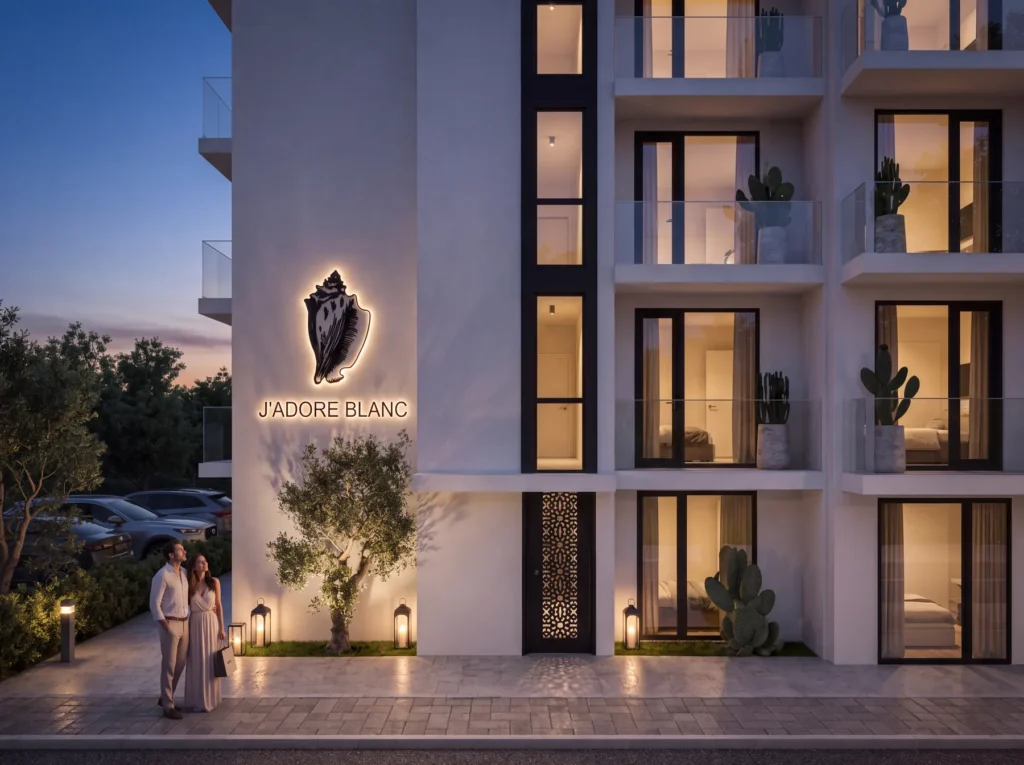 Under constructionJ’ADOREBlanc 1–2
 CompletedJ’ADORESecret Garden
 Completed · front lineJ’ADOREDune